A high-volume employer in México replaced its first-round phone screening with a voice AI interviewer built on Reclutalia, the recruiting product of DaCodes. Throughput went from about 1,000 calls a month to about 1,000 calls an hour, a 720x increase, with every call transcribed, scored and written to the ATS. The client is anonymized; the figures are from the DaCodes Proof Ledger (Sep 2026).
The situation
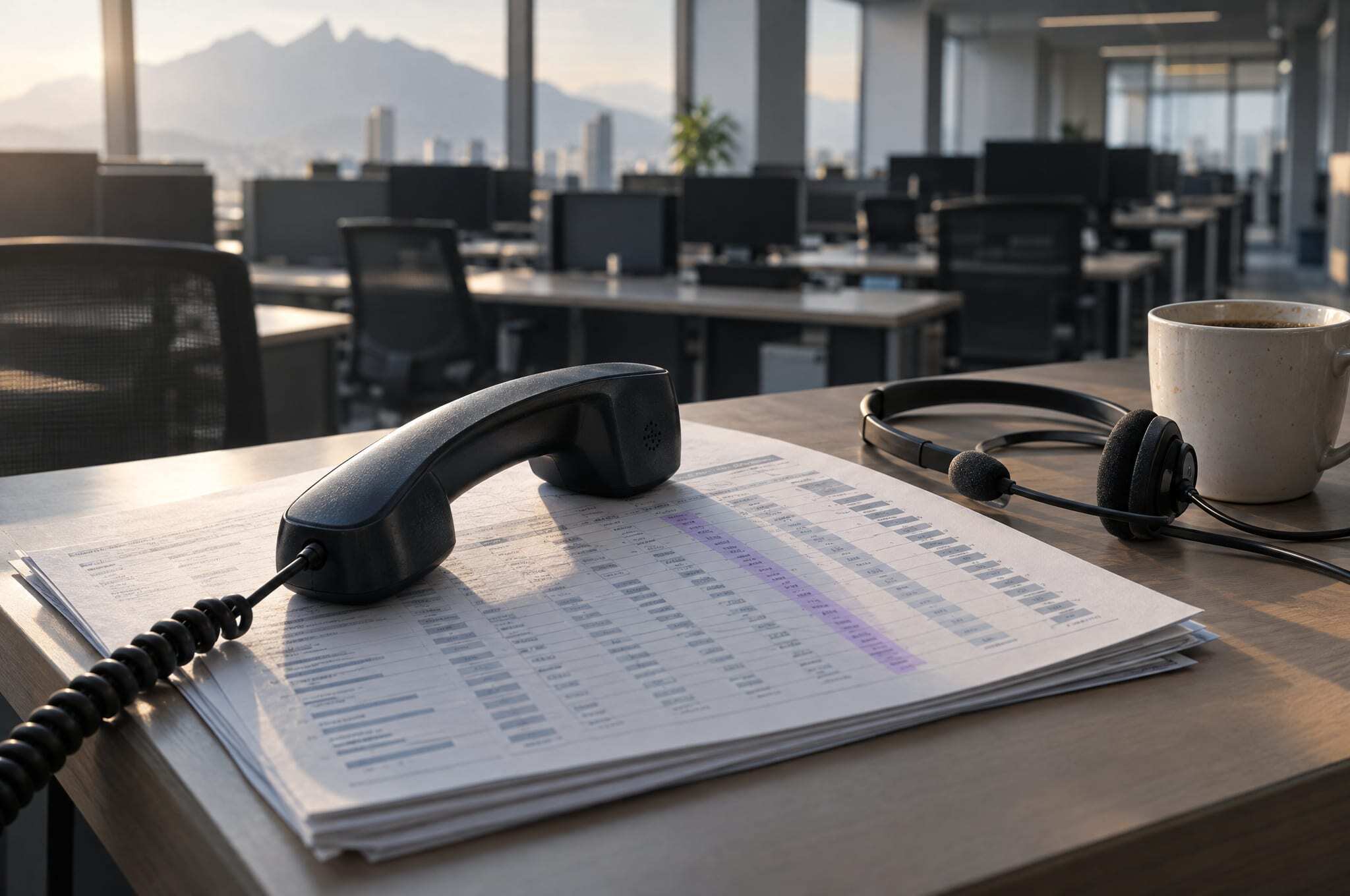
Mass hiring has a math problem. When a company needs hundreds of frontline hires a month, the first phone screen is the bottleneck: a recruiter makes a few dozen calls a day, many go unanswered, and the candidate who finally picks up has already accepted another job. The funnel is lost at the top, and the recruiters spend their week dialing instead of deciding.
What we signed
Primary KPI: screening throughput, measured as completed first-round interviews per hour of capacity. Guardrail: recruiter agreement with the agent's score on a sampled set of interviews, reviewed weekly. Consequence: if the throughput target set at Blueprint was not met at the commitment gate, no Scale phase and no retainer.
What the interviewer does
- Receives: a candidate applies or is imported; the agent calls in the window the candidate chose, by phone or WhatsApp.
- Looks up: the role's requirements, the location, the shift and the documents needed, from the ATS.
- Decides: which question to ask next based on the answers, when to probe, when to end early because a hard requirement is missing.
- Acts: writes the transcript, a structured score and a recommendation to the ATS, and books the in-person interview for candidates who pass.
- Escalates: unclear answers, accessibility needs or a candidate who asks for a person go to a recruiter with the full context.
- Learns: recruiters correct scores in the ATS; the corrections feed the weekly evals.
- Voice
The voice stack that makes the volume affordable
A thousand calls an hour is only interesting if each call is cheap. The interviewer runs on the DaCodes voice stack, speech recognition, an open-weights language model and speech synthesis hosted in the client's cloud, at about $0.035 per 15-minute call, measured internally in August 2026, against $2.56 to $5.17 per call on commercial voice APIs. At mass-hiring volume, the difference is the budget.
Results
- Throughput: about 1,000 screening calls a month to about 1,000 an hour, 720x (Proof Ledger, Sep 2026).
- Every call transcribed, scored and written to the ATS; no recruiter retyping.
- Recruiters moved from dialing to reviewing shortlists and running final interviews.
Source: the client's ATS and call logs, verified in the DaCodes Proof Ledger, Sep 2026.
720x
screening throughput
Proof Ledger, Sep 2026
1,000
calls an hour, from 1,000 a month
Proof Ledger, Sep 2026
$0.035
per 15-minute call on the DaCodes voice stack
DaCodes, Aug 2026
What the recruiting team sees
In the ATS, every candidate carries the transcript, the structured score against the role rubric and the recommendation. On the Agent Console, the recruiting lead sees completed calls per hour against the target, the recruiter agreement rate from the weekly sample, spend this month and the audit trail of every call. An override takes one click and is logged as eval data, so the rubric improves from the corrections instead of drifting away from them.
What we watched for
Screening candidates with AI raises fair questions, and we treated them as design constraints. The agent asks the same structured questions to every candidate for a role. It never makes the hiring decision; it produces a score and a recommendation a recruiter can override in one click. Candidates are told they are speaking with an AI interviewer and can ask for a person at any point. Personal data stays in the client's tenant, and the scoring rubric is versioned so a recruiter can see why a score changed.
The hardest part was not the reasoning
It was the audio. Candidates for frontline roles answer from the street, the bus and the store floor. The first evals were dominated by transcription errors, not by bad questions. Tuning the speech layer for noisy audio and adding a confirm-back step for names, dates and documents took most of the first sprint. Both are now part of the reference architecture every new deployment starts from.
What happens next
The same interviewer is a Library agent. For a new client it needs 2 to 4 weeks of tuning inside the pilot: role rubrics, tone, the ATS integration. The pilot itself reaches production in 8 to 12 weeks, with its own KPI Contract.
A thousand calls an hour is only interesting if each call is cheap.
Sarah Mousa
Content and Proof Ledger